
Sultana’s Last Voyage
The deadliest maritime disaster in American history

Prior to the Civil War, the Mississippi River and most of the nation’s inland waterways were highways for steam powered, paddle driven boats that served as both floating hotels and merchant ships. Mostly privately owned and independently operated, these ships tied together what was at the time a loose union of States, with the nation commonly referred to as “these” United States, as opposed to “The” United States. The ships were rapidly and cheaply constructed, with an average service life of about 5 years. As they were replaced, names were often reused.
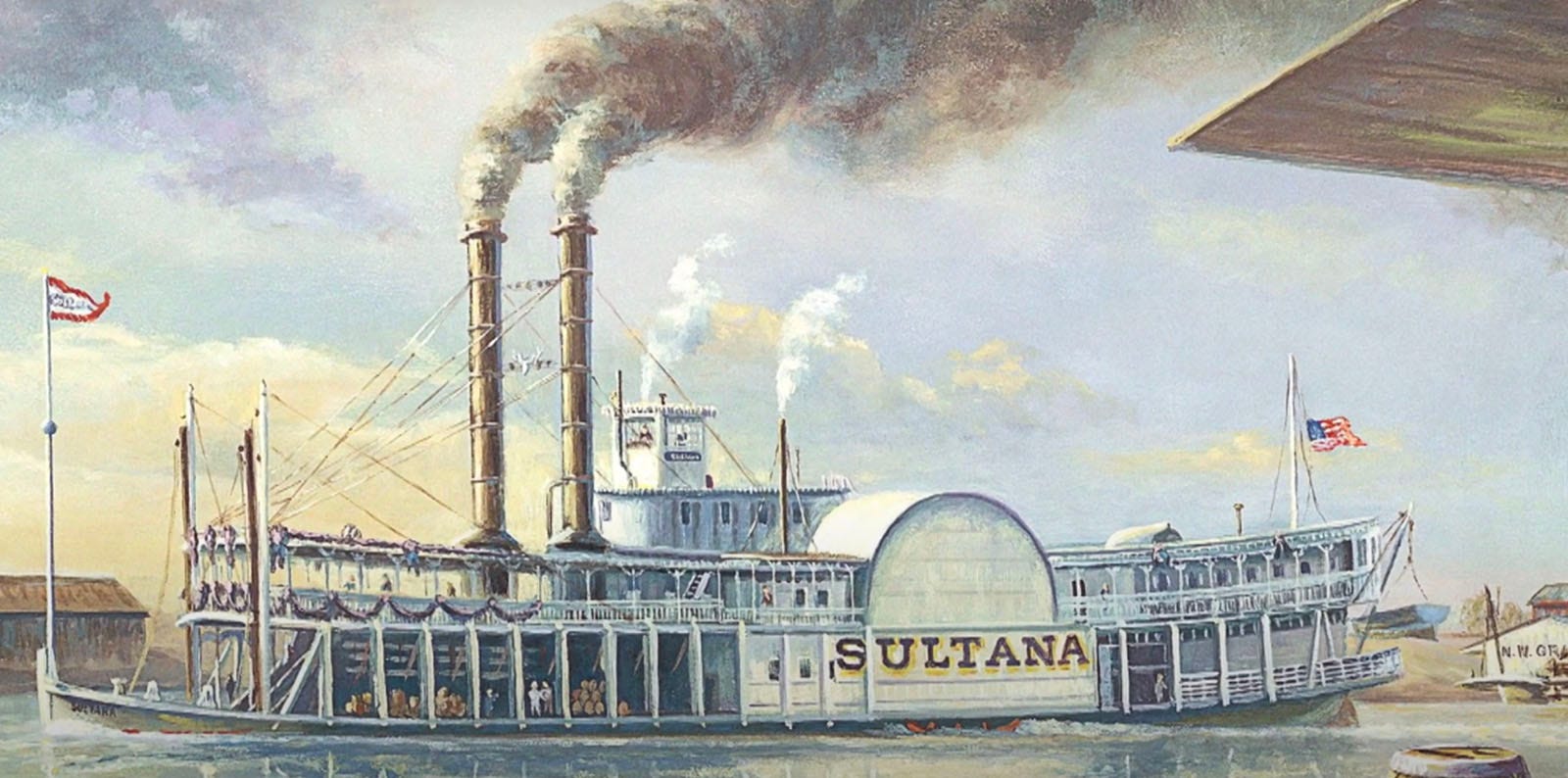
Such was the case with the Sultana, and the Sultana described in this post was the fourth to bear that name, which had a legacy of being among the largest and fastest in service. Sultana, like most steamboats of the time which, to cut costs, used similar construction, was a sidewheeler. Constructed in Cincinnati, Ohio, Sultana was launched on January 2nd, 1863. The war was still raging, but the Union was close to controlling the Mississippi, and Sultana was anticipating the reopening of commerce on that waterway.
On February 11, 1863, Sultana began its first voyage on the Ohio River with a cargo of freight heading to Pittsburg, Pennsylvania. It had to unload in Wheeling, Virginia (today’s West Virginia), as the ship was too large to pass underneath a bridge there. Sultana’s size and speed may have prevented its reaching Pittsburg, but it also caught the eye of the Union’s federal government, which claimed the right to requisition any civilian boat they needed in exchange for a baseline pay … which was far below the pay that could be earned on the civilian market. With the opening of the Mississippi shortly thereafter and the Union’s need to transport troops and supplies, Sultana struggled hard in between government contracts to make a living and relying on its speed to attract commercial business. This resulted in Sultana’s boilers being consistently pushed to the limit, showing signs of overuse long before normal.
While under Union control, Confederate forces still managed to fire on the Sultana from the river’s banks on at least two occasions, inflicting minimal or no damage each time. The greatest threat to Sultana was pushing the ship to its limits in order to remain profitable. This resulted in the boilers requiring multiple repairs, which were often rushed in order to get the boat back in service as quickly as possible. This was the Sultana’s life for two years.
In April of 1865, the war was rapidly drawing to a close, and prisoner releases were being arranged. Both sides had notoriously inhumane prison camps, but they were particularly bad in the south if for no other reason than the Union’s brutal campaigns there had made it difficult to feed, clothe and house the Confederate’s own troops and civilians, let alone the Union prisoners they held. The Union was contracting with as many steamers as it could to bring released prisoners in the south back home.
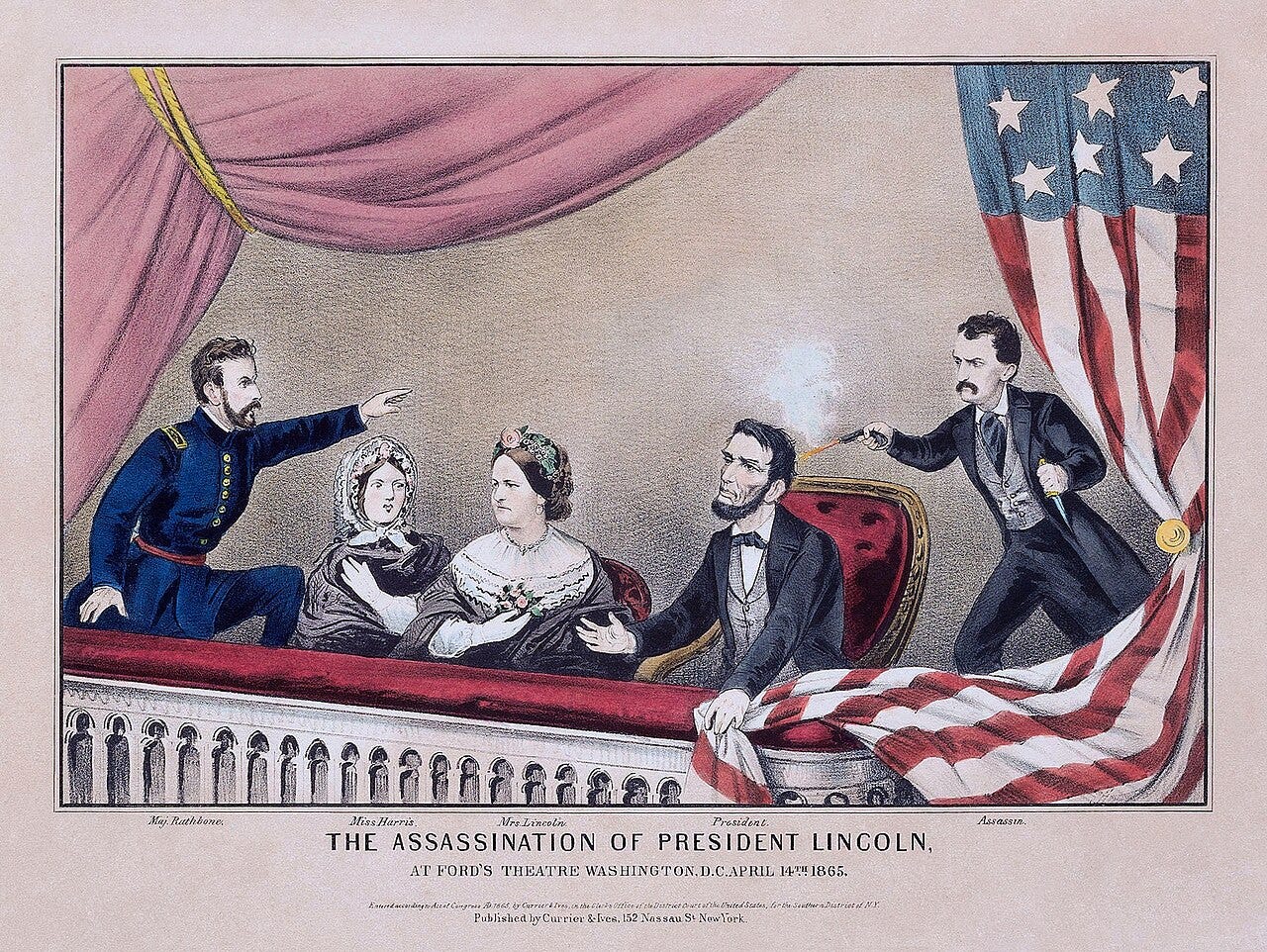
On April 14th, 1865, President Lincoln was felled by an assassin’s bullet. Sailing south on the Mississippi, the Sultana had stopped in Cairo, Illinois when it learned of the assassination. Knowing that the news had likely not yet traveled down the river (telegraph service had been destroyed in the south), Sultana loaded up with newspapers and draped its decks in black, spreading the news as it continued south on the river with its flag at half-mast. As it spread the news, Sultana earned the moniker, “the messenger of death.” In a cruel twist of fate, it would turn out that “the messenger of death” was on its final voyage.
Sultana’s southern journey ended in New Orleans, where it was contracted to pick up 1,000 released Union prisoners in Vicksburg on its way back upriver. Sultana’s normal passenger capacity was 376, along with 85 crew members. Even though that many returning soldiers was already far beyond the boat’s rated capacity, Sultana took on 40 passengers and 150 tons of cargo in New Orleans in order to maximize the trip’s profit before heading north to Vicksburg.
South of Vicksburg, a seam ruptured in one of the boilers, slowing Sultana significantly. Limping into Vicksburg, a boiler repairman was brought onboard to patch the ruptured seam, but initially refused to do a rushed job, agreeing only after Sultana promised to put in for major repair upon completing the journey north. Sultana then took on its complement of released prisoners … all frail, mostly sick and malnourished, with many wounded. But the Union didn’t put 1,000 men on Sultana, the final count was much closer to 2,000. Sultana also took on some additional passengers, and over 100 horses. With the additional passengers, Sultana now had about 2,200 souls onboard, along with the cargo and livestock. Grossly overloaded, with a hastily patched boiler, Sultana continued it voyage home.
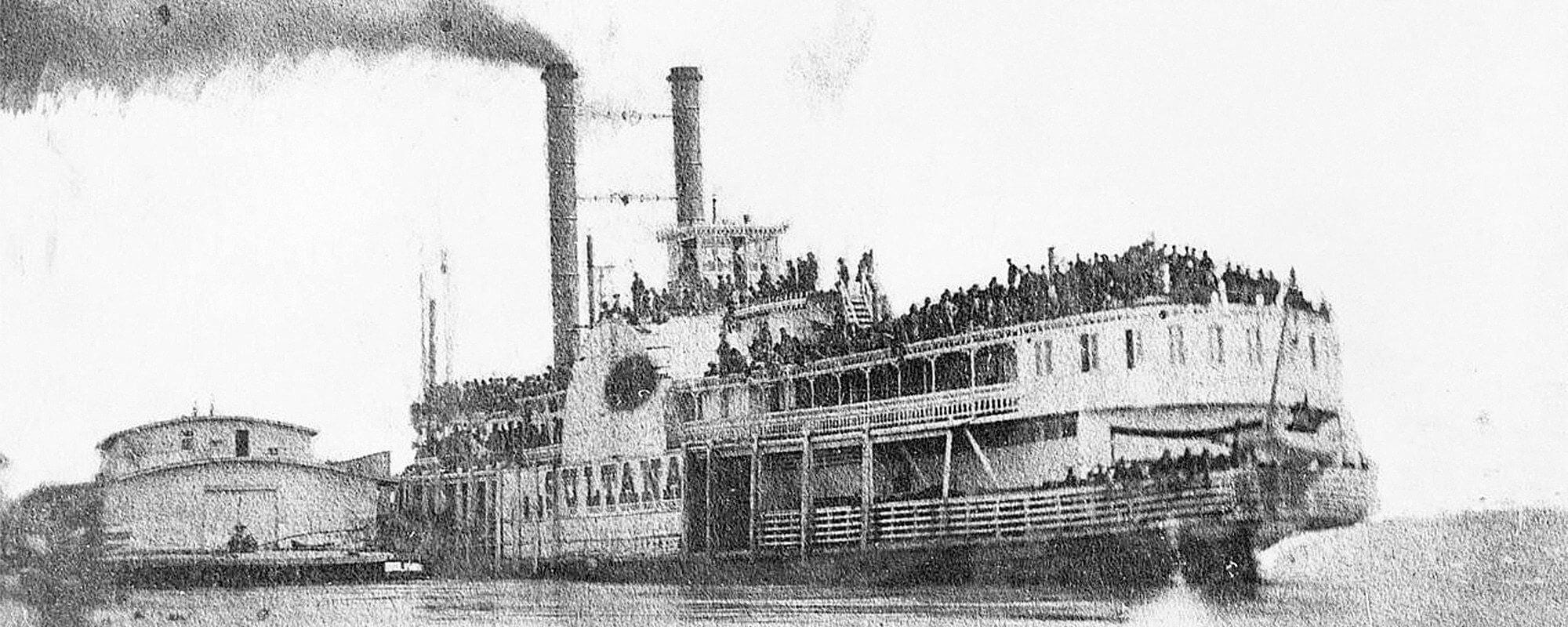
At a port stop in Helena, Arkansas, a photographer snapped one of the only two known photos of Sultana (pictured above), documenting how overcrowded it was. The massive overcrowding would cause the boat to lean to one side if the weight wasn’t evenly distributed, as was often the case as the soldiers milled about. The crew had to constantly admonish the soldiers to move to one side or the other to keep the boat level. It was not in danger of capsizing, but an excessive lean would cause the water in the boilers to pool to one side, exposing the heating tubes on the other. The exposed tubes would then superheat, and when the ship leveled again the water hitting the superheated tubes would instantly vaporize, reducing the water levels at best, and creating explosive pressure at worst. Sultana was flirting with disaster.
After a brief stop in Memphis to off load some cargo, Sultana set out to complete its journey north at about 11pm. Traveling along the east side of the river where the currents were weaker, Sultana eventually reached a bend in the river where it became necessary to cross to the west side. As it did, the river current was against the starboard side causing a sustained lean toward port. Today … April 27th, 1865 … at about 2am when Sultana completed the crossing and leveled out again, the water in the boilers hit exposed superheated tubes, and 3 of the four boilers exploded. This wasn’t a fire explosion, it was superheated steam, and the explosion ripped upward through all the decks above, scalding or killing hundreds of the passengers. Wooden debris from the damaged decks then fell into the exposed boiler coals, instantly igniting. After that, Sultana would burn to the waterline and sink.
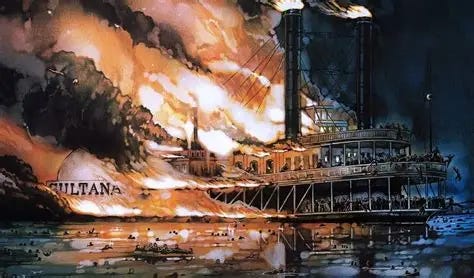
1,167 passengers and crew would die with Sultana, “the messenger of death,” making it to this day the deadliest maritime disaster in American history.
NEXT WEEK: Tin soldiers and Nixon coming